How to train your metabolism
July 31, 2026
Many people don’t realize that your metabolism is something you can train directly.
In other words, through training, you can improve the way that your body converts food into energy.
Here’s one example:
Say we had two people run a 5k for max effort. One is trained and the other is untrained.
The trained person will produce their energy from a ~50/50 mix of carbs and body fat. The untrained person will utilize almost exclusively carbohydrate for fuel.
The same idea is true at rest: the trained person is using more fat to fuel their daily functions (breathing, heart beating, etc.) than the untrained person.
This isn’t an isolated example. There are many ways your actual physiology improves in response to this sort of training.
This is what it means to do “conditioning” as a form of training:
To target and develop specific energy systems that your body is using on a daily basis.
If you’re trying to build truly robust and well-rounded fitness, this is one of the most important topics to consider.
So, in this week’s newsletter we’ll briefly go over the three energy systems to train and how to develop them.
If you'd like a more detailed discussion, check out this article/video.
Overview
There are three energy systems your body uses:
Creatine phosphate system
Fast glycolysis
Oxidative system
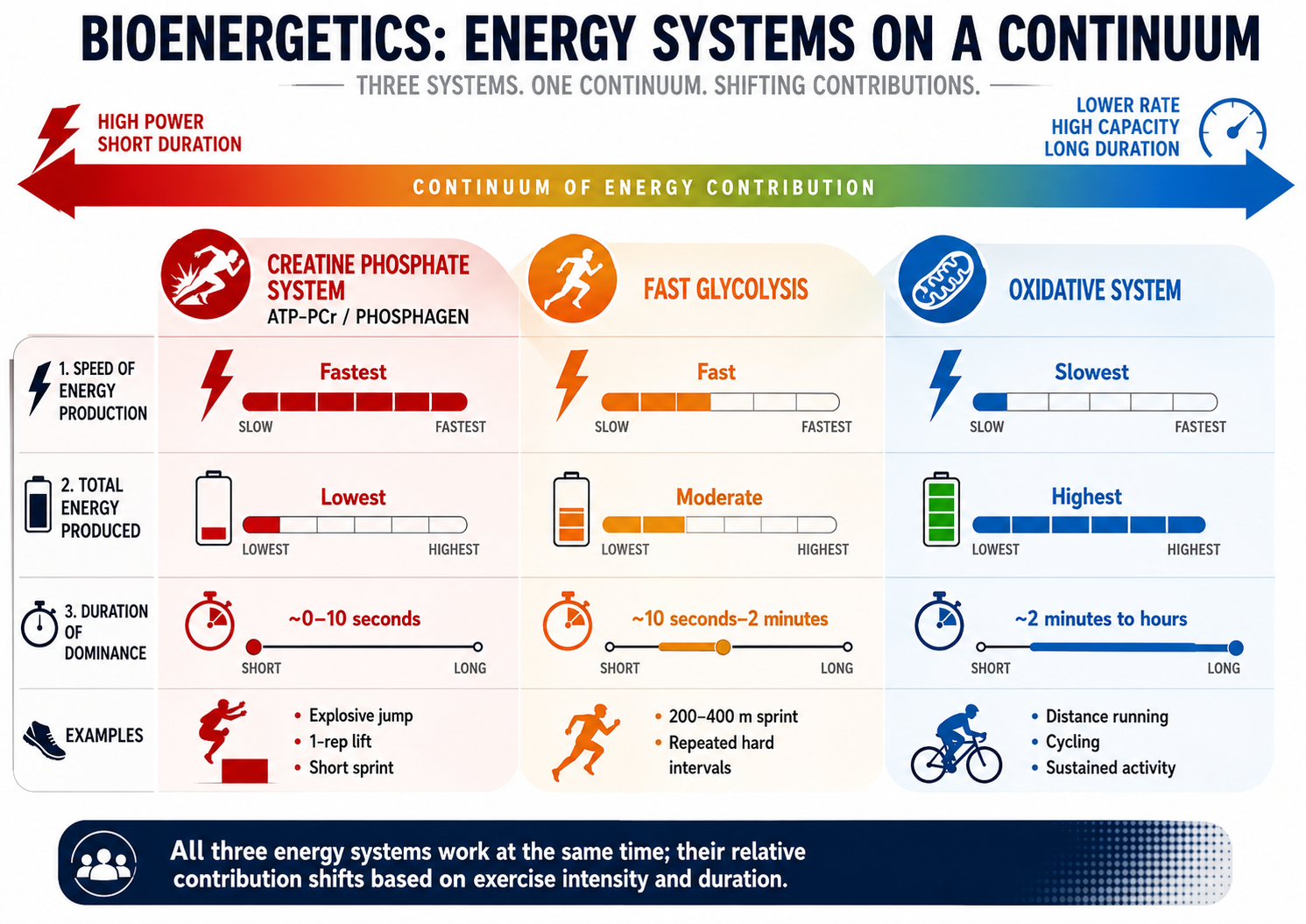
The difference between them is:
How quickly they can produce energy
How much energy they can produce before fatiguing
How long they can produce energy for
So, your body will preferentially bias one over the others depending on how intense the exercise is that you’re doing.
It’s worth noting that they are all active all the time; it isn’t like only one is on at any point in time.
This is part of the reason why they are all important to develop to some degree; no matter what your goals are.
For the purpose of structuring your training, though, you can view them as being isolated.
Energy system #1: Creatine-phosphate system
This system produces energy very quickly, but doesn’t produce a lot of it nor can it do so for very long.
Activities that rely on this energy system include jumping, heavy lifting, sprinting, etc.
Basically anything that is maximum effort for ~1-30 seconds.
Normal strength training will rely on its energy production from the creatine-phosphate system.
However, if you want to truly train and develop this energy system, you will need something different.
The reason being is that normal strength training is often limited by things other than energy production itself, such as the mechanical tension of the muscles you’re training.
So, to develop this energy system, you’ll need something that is limited by energy production from the creatine-phosphate system alone.
One option would be jump training or sprinting.
Another would be to use an AirDyne, rower, SkiErg, or anything similar and do max effort sets of 10, 20, or 30 seconds with ~2:00 of rest in between sets.
As you may have guessed, this energy system is what creatine supplementation helps specifically.
Here, the amount of creatine available to be used in the muscle limits how much energy can be produced.
When you supplement with creatine, your muscles become saturated, and the amount of fuel available for this energy system becomes maximized.
As a result, your performance on any exercise that relies on this energy system improves. In addition, training this energy system directly becomes that much more effective when you supplement with creatine.
Energy system #2: Fast glycolysis
This energy system can produce more energy, and do so for longer, than the creatine-phosphate system.
However, it doesn’t produce that energy as fast as the creatine-phosphate system can.
This is your main source of energy in any activity that lasts ~30—120 seconds.
Examples would include higher rep weight lifting, high intensity running such as a 400 or 800 meter run, or high intensity swimming such as a 50 or 100 meter swim.
One way you can train this energy system is by doing sets of high effort exercise within this specific time frame.
An example would be getting on a rower and then rowing as many meters as you can within 30—120 seconds.
Or, you can use intervals, where the ‘hard’ intervals last 30 seconds to 2 minutes.
An example of this could be:
2 minutes of running at 4/10 effort
2 minutes of running at 9/10 effort
Repeat 3-5x with no rest in between
The key is that you need to get somewhat close to exhaustion with each bout to adequately train this energy system.
Training this would also be best accomplished with modalities such as running, swimming, cycling, AirDyne, rowing, SkiErg, etc.
Two supplements that benefit this energy system directly include beta-alanine and sodium bicarbonate.
When this energy system is stressed, it produces a build-up of acid within the muscle. This acid build up can limit further energy production and muscle contraction.
These two supplements act as bases that limit this acid build-up, therefore allowing you to use this energy system more effectively.
Energy system #3: Oxidative system
This energy system can produce the most energy, and do so for the longest, by far.
It does so more slowly than the previous two, though.
This energy system fuels any activity lasting longer than 3 minutes.
It’s also the energy system that is predominately fueling you right now at rest.
In order to train this energy system, there are two approaches you should take:
First, you train at a low intensity (e.g. 60-75% max heart rate) and rack up as much volume as you have time for.
An example could be:
30-60 minutes
60-75% max heart rate OR ~4-5/10 effort
Bike, run, AirDyne, Rower, stairs, rucking, incline walking, or anything similar
2-3x/week
Second, you perform max effort sets or intervals, similar to how I described for fast glycolysis, but you make the bouts last 3 minutes or longer.
An example session could look like:
2 minutes of treadmill running @ 4/10 effort
4 minutes of treadmill running @ 8-9/10 effort
repeat 3-4x
One supplement that benefits this energy system is beetroot/nitrate supplements.
This system is dependent on oxygen. Nitrate supplements improve oxygen delivery to the working muscles, therefore allowing this energy system to work harder for longer.
Putting it all together
This can all seem like a lot to juggle. Especially in combination with strength training.
However, in practice, it can be quite simple.
I'll give you two examples to show what I mean.
Example 1: 4 day per week schedule
Here, you'll have four training days total across the week.
Two will be full body strength, with one or both containing creatine-phosphate focused sprints.
One session will be a true easy run, where effort doesn't exceed ~5/10. This can last 30 minutes, 60 minutes, 90 minutes, etc. It all depends on where you're at.
One session will be interval running, where you include glycolysis focused intervals as well as oxidative focused intervals.
Example 2: 6 day per week schedule
Here, the training week could look like the following:
Monday: Full body strength
Includes creatine-phosphate focused sprints
Tuesday: Lower body focused easy endurance
e.g. easy running, cycling, rucking, incline walking, stairs, etc.
Wednesday: Upper body focused easy endurance
e.g. swimming, SkiErg, rowing, AirDyne, etc.
Thursday: Lower body hypertrophy (muscle growth)
Friday: Upper body hypertrophy
Saturday: intervals
Includes glycolysis and oxidative focused intervals
Enjoyed this issue?
Subscribe to get every issue →